
One Thousand Years of Light:
A Legacy of Wonder Now on View in SDMA’s Arts of Iran Gallery
Ladan Akbarnia, Ph.D., Curator of South Asian and Islamic Art
From September 7, 2024, through January 5, 2025, The San Diego Museum of Art’s exhibition Wonders of Creation: Art, Science, and Innovation in the Islamic World brought together over 220 stunning artworks made across the globe over twelve centuries, each of them illustrating the intersections of art and science and the rewards of viewing the universe through the lens of wonder. Thirty-five lenders—including public and private collections in the United States, Europe, Egypt, Kuwait, and Malaysia—contributed to this major project supported by substantial grants from the Getty Foundation, the National Endowment for the Humanities, and the National Endowment for the Arts, as well as by other generous donors. Wonders of Creation then traveled to the McMullen Museum of Art, Boston College, from February 8 through June 5, 2025, where it became the focus of several local courses and conferences.
One of the works too large to travel to the Boston venue was One Thousand Years of Light, a large-scale commission by artist Ala Ebtekar, which stunned audiences as they entered the exhibition’s section on the celestial realm. Conceived specifically for the exhibition, this impressive work features a composite image of the sun superimposed over fifteen copper plates etched with sources on timekeeping, optics, and the universe, occupying a surface area of ninety square feet. From afar, it resembles a bright, radiating sun, while up close, each plate reveals the image of a manuscript folio or printed page representing a historical source on light. Now San Diegans and other visitors are invited to experience the awe and wonder of Ebtekar’s moving installation in the Museum’s Arts of Iran Gallery, where One Thousand Years of Light will remain on view for the foreseeable future.
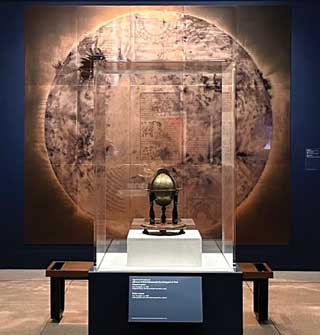
Installation view of Ala Ebtekar’s One Thousand Years of Light in Wonders of Creation: Art, Science, and Innovation in the Islamic World at The San Diego Museum of Art (photograph by Mai Kolkailah).
Ala Ebtekar, One Thousand Years of Light, 2024. Pigmented acrylic ink on etched copper; 15 plates. The San Diego Museum of Art, Museum Commission, 2024.28. Courtesy of The San Diego Museum of Art.
The following excerpt from the exhibition’s accompanying publication provides a more detailed description of this important work, which was acquired by the Museum as part of the commission agreement:
The plates display excerpts of works by Qazwini and several astronomers, mathematicians, physicians, and poets from Iran, Iraq, and Morocco, whose original texts date from the eleventh to seventeenth centuries. Excerpts of Qazwini’s cosmography appear on a plate reproducing a folio from an incomplete Ottoman translation dated 960 ah (1553) and on three other plates containing pages from a Persian lithographed edition printed in 1310 ah (1892). Among the other sources, the earliest reference is to Ibn al-Haytham (also known as Alhazen, d. 1040), the medieval astronomer, mathematician, and physicist known primarily for his multivolume treatise on optics, Kitab al-Manazir (Book of Optics). Here Ebtekar represents Ibn al-Haytham —the first to provide a clear description and analysis of the camera obscura, or pinhole camera—through a folio from a compendium that includes the scholar’s Maqala fi surat al-kusuf (Discourse on the Shape of the Eclipse). Another early reference comes through the verses of Omar Khayyam (d. 1131), the astronomer and mathematician more popularly remembered as a poet today. Further plates contain excerpts from an encyclopedia of practical astronomy and astronomical instruments by Ibn al-Bannaʾ al-Marrakushi (d. 1321), a Sufi astronomer, astrologer, and mathematician from Marrakesh, Morocco, through one copy made in sixteenth-century Ottoman Türkiye, Egypt, or Syria and another produced in the seventeenth century; an astronomical compendium by al-Jaghmini (d. ca. 13th century), an Arab physician and astronomer from the Khwarazmian village of Jaghmin in Uzbekistan; a commentary on al-Jaghmini by the Ottoman astronomer and mathematician Qadizadeh al-Rumi (d. after 1440); and a nineteenth-century copy of a text on the making of astrolabes by the Persian astronomer and astrolabe maker Qasim Ali Qaʾini (active 17th century).
The pages printed on each copper plate come from historic manuscript or lithograph printed copies of the scholars’ original works, the copies dating from the thirteenth to nineteenth centuries. Using the intaglio printmaking process of etching or, more specifically, photogravure, each image was transferred to a smoothly polished plate by an Ultraviolet (UV) printer, applied as a thick layer of acrylic hard ground. The plates were then dipped into a ferric chloride bath for fifty-five to sixty minutes, allowing the acid solution to etch into the exposed areas of their surfaces to produce each image. Afterward, the ground was carefully peeled away, and UV-cured pigmented acrylic ink was applied to the etched recesses and entire copper plate.
Ebtekar links these etched historic references to the present through a stunning image of the sun as seen from a distance of 75 million kilometers (over 46.5 million miles), superimposed across all fifteen plates in a second printing. This portrait comprises a mosaic of twenty-five individual images captured on March 7, 2024, by the European Space Agency’s Solar Orbiter. Ebtekar researched images in the Solar Plate Archive at Carnegie Observatories in Pasadena, California, initially intending to use a historic image of the sun for the large-scale portrait. When he came across the present composite one, he was moved to use it instead, fascinated by its stunning resolution. The image reveals the sun in its entirety, including its glowing outermost layer, the corona, which boasts a temperature a hundred times hotter than the sun. Taken at a wavelength of 17 nanometers by an instrument designed to capture the extreme ultraviolet region of the electromagnetic spectrum, the resulting image is the highest resolution image of the sun to date.
Referenced across the surfaces of its fifteen plates, the final portrait of the blazing sun in One Thousand Years of Light encompasses over a millennium of knowledge attained because of human curiosity, contemplation, and discoveries about light and the marvels of the celestial realm. Ebtekar writes us into a cosmography that ultimately transcends time, engaging and incorporating us into a continuous dialogue about and with the universe. Echoing similarly layered approaches in Zenith II (moonlight) and other examples of the artist’s work, Ebtekar’s multifaceted practice reflects intellectual, material, and technological research into the history of image making across cultures, layering different scientific techniques and theories to explore the idea of the cosmos and transcendence.
One Thousand Years of Light reminds us of our respective roles within an interconnected cosmos, its many layers suggesting that we exist in the same universe across time. One of my favorite references in this work can be found in a quatrain by Omar Khayyam reproduced on one of the central plates:

I cannot conceal the sun with mud / Nor can I speak of the secrets of time [the world/universe] / From the sea of contemplation, wisdom brought forth / A pearl that I cannot pierce [write about] out of fear.
These verses by one of Iran’s greatest polymaths and poets capture the overwhelming sense of wonder that comes from seeking knowledge about the universe we inhabit, a wonder that may yield pearls of wisdom so precious that even the most erudite among us, like Khayyam, dare not articulate it in words.
***