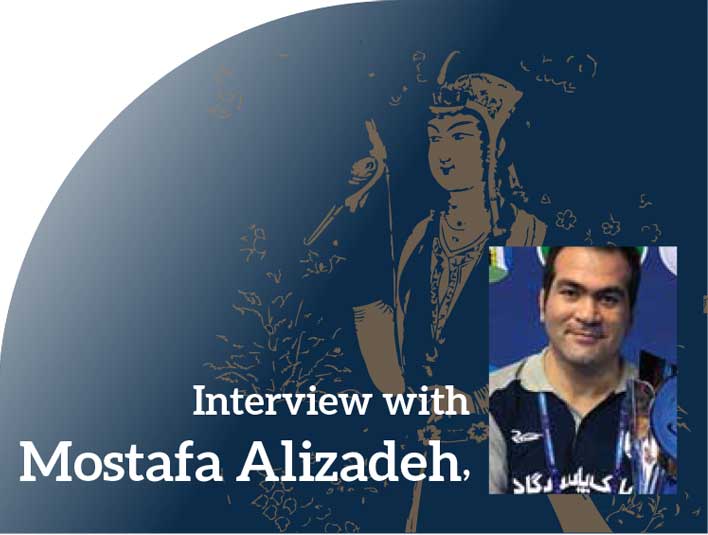
Interview with Mostafa Alizadeh, Former Member and Coach of the Iranian National Wrestling Team
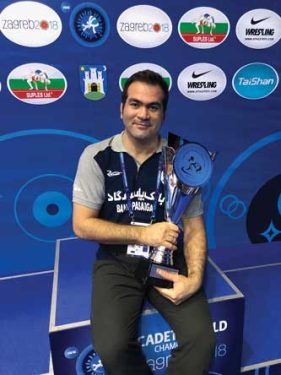
A few weeks ago, at the beginning of the new academic year, I met Mr. Mostafa Alizadeh, who was at school to enroll his child. I quickly learned that he is one of the champions of Iranian wrestling, a former national team member, and a national champion of Iran, an Asian champion, and a world champion. This coincided with the World Wrestling Championships in Zagreb and the remarkable performance of Iranian wrestlers in both freestyle and Greco-Roman styles. Seizing the opportunity, I sat down with Mr. Alizadeh to introduce him to the Iranian American community in San Diego and to get his views on wrestling in Iran and the unprecedented recent championships of both teams. I should note that the interview was originally conducted in Persian.
Ali Sadr
Ali Sadr (AS): Mr. Alizadeh, welcome to San Diego. Please introduce yourself to our readers.
Mostafa Alizadeh (MA): Thank you, Mr. Sadr, for inviting me to this interview! I’m glad to be here in an Iranian American media outlet serving my dear compatriots! I am Mostafa Alizadeh, born in Bahman 1358 (January 1980) in Mashhad. I started wrestling 35 years ago with the encouragement of my older brother, who is one of the Iranian national champions and also wrestled on the international stage, and is currently the coach of the Iranian youth national team. I have been wrestling and coaching for the past 35 years. Perhaps for the sake of time, it would be better that I provide you the list of my achievements separately.*
AS: Please tell us about the history of wrestling in Iran and how it differs from traditional wrestling styles.
MA: Wrestling is the oldest sport in Iran, with roots dating back thousands of years. From the carvings of Persepolis and the Shahnameh of Ferdowsi to the Zurkhanehs and the tradition of heroism, wrestling is not just a sport but a part of the national identity and the tradition of heroism among Iranians. In modern times, both freestyle and Greco-Roman wrestling have been recognized as official Olympic disciplines, and Iran has managed to become one of the dominant powers in the world in these sports due to its historical background and inherent talents.
AS: When did modern wrestling emerge in Iran?
MA: The introduction of freestyle and Greco-Roman wrestling to Iran dates back to the early twentieth century. In the 1320s and 1330s (1940s and 1950s), the first national teams of Iran were formed, and Iranian wrestlers began participating in international competitions. From the very beginning, freestyle wrestling found a special place in Iran, with champions like Gholamreza Takhti, Emamali Habibi, and Abdollah Mohammadi bringing Iran’s name to the global stage. Greco-Roman wrestling developed a bit later in Iran, but with the dedication of coaches and hardworking wrestlers, Iran has managed to become one of the leading powers for more than the past two decades.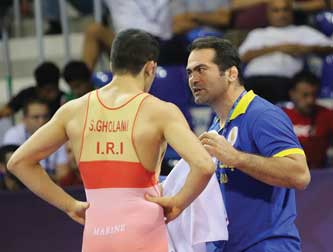
AS: Who have been the prominent figures in this sport over the past seventy to eighty years?
MA: Dear Mr. Sadr! Wrestling is so intertwined with the history, culture, and sports of Iran that hundreds of names can be recalled from writings, poetry, and ultimately the competitive history of this sport. However, to summarize, the Iranian freestyle wrestling team has repeatedly stood on the podiums of the Olympics and World Championships, with champions such as Gholamreza Takhti, Hassan Yazdani, Abdollah Movahed, Emamali Habibi, Amir Hossein Zarei, Alireza Dabir, Alireza Heydari, Reza Yazdani, and the Khadem brothers being among the most famous freestyle wrestlers of Iran. Iran’s Greco-Roman wrestling has also brought home honors multiple times in the Olympics and World Championships. Champions like Hamid Sourian, Hassan Rangraz, Firooz Alizadeh, Mohammadreza Gerayi, Ghasem Rezaei, Omid Norouzi, Saeed Esmaeili, Hadi Saravi, Saeed Abdolahi, and Mohammad Ali Gerayi are notable figures in Iranian Greco-Roman wrestling.
AS: You mentioned the Olympics. How is Iran’s ranking in the Olympics?
MA: Iran is considered one of the most successful countries in the Olympics in both freestyle and Greco-Roman wrestling, having won a total of 13 gold, 19 silver, and 23 bronze medals. Freestyle wrestling accounts for 7 gold medals and Greco-Roman wrestling for 6 gold medals.
AS: Thank you for this detailed information. How about the Asian and World Championships? What are Iran’s records like?
MA: Iran’s freestyle and Greco-Roman wrestling have won dozens of World Championship medals so far and have repeatedly been among the world’s leading teams in recent years. Throughout history, the Iranian freestyle wrestling team has won the championship title six times, while the Greco-Roman team has achieved this title twice.
The national team of Iran has always been the leading power in Asia in both freestyle and Greco-Roman wrestling, having earned hundreds of medals.
AS: You previously mentioned that wrestling in Iran is more than just a sport. Could you elaborate on this?
MA: Of course. Much has been said and written about the social and cultural status of wrestling. In Iran, wrestling is not just a competitive sport; it is a symbol of ethics, masculinity, and heroism. Champions like Gholamreza Takhti are cherished not only for their medals but also for their ethics and humility. Wrestlers have served as moral role models for younger generations, with many values of heroism, such as helping the needy, humility, and respect for opponents, being passed on through this sport. Freestyle and Greco-Roman wrestling in Iran have long been an integral part of Iranian culture and identity. From the heroes of the Zurkhaneh to Olympic champions, all have demonstrated that Iran is the cradle of wrestling and heroism. Internationally, Iran has always been among the main powers in these two disciplines, and the future is promising for the continuation of this honor.
AS: What are your thoughts on the recent championships of the Iranian teams, and do you believe these successes will continue?
MA: The national teams of Iranian freestyle and Greco-Roman wrestling recently achieved remarkable results in both styles, winning 15 medals—gold, silver, and bronze—thus becoming world champions for the first time in history. This achievement comes after the freestyle team last claimed the championship title 12 years ago and the Greco-Roman team 11 years ago. However, to win the championship in both styles is an unprecedented record that has occurred for the first time in Iranian sports history.
In freestyle, the team secured the championship with 2 gold medals, 2 silver medals, and 3 bronze medals, earning 145 points. The teams from the U.S. and Japan ranked second and third, with 134 and 111 points, respectively.
In Greco-Roman wrestling, Iran staged an astonishing and unprecedented performance, winning 4 gold medals, 2 silver medals, and 2 bronze medals, totaling 180 points to clinch first place. The teams from Azerbaijan and Uzbekistan placed second and third with 89 and 72 points, respectively.
In my opinion, Iranian wrestling has attained these remarkable results by utilizing a well-organized infrastructure plan regarding equipment and facilities based on global standards—and perhaps even beyond that—along with the presence of a brilliant and unprecedented generation of talented and promising youths in the national Greco-Roman and freestyle wrestling teams.
I believe another key factor behind the success of the Iranian teams in 2025 has been excellent planning in fitness and the use of specialized coaches in the composition of the national teams.
AS: After the recent competitions in Zagreb, many analysts mentioned the composition of the freestyle team, which was primarily from Mazandaran Province, while most members of the Greco-Roman team were from southern Iran, particularly Khuzestan Province. What are your thoughts on this?
MA: Indeed, Mazandaran can be considered the beating heart of wrestling in Iran and the world. Nowadays, when Mazandaran is mentioned, perhaps the first word that comes to mind—especially for sports enthusiasts—is wrestling! In Mazandaran, wrestling is synonymous with life! Almost every family has one or more members who have either wrestled or plan to wrestle. Historically, the success of Iranian national wrestling teams, especially in freestyle, has depended significantly on the achievements of our brave Mazandarani wrestlers.
Since 1948, when Iran attended the Olympics and later in world championships, Mazandaran has been the most significant hub of this sport. More than 70% of the medals obtained in world championships and Olympic wrestling competitions have been won by wrestlers from Mazandaran!
However, the situation is somewhat different in Greco-Roman wrestling. Although over the past two decades, Greco-Roman wrestling in Mazandaran, Tehran, and earlier in Ardabil has achieved considerable success, southern Iran—specifically Khuzestan—has historically been a leader in this sport!
Given the current conditions and the strong presence of Iranian national wrestling teams on the global stage, I believe that at least within the next year or two in freestyle wrestling and four or five years in Greco-Roman wrestling, Iran will be recognized as the number one powerhouse in world wrestling, and we should expect even more honors from Iranian athletes in this sport.
AS: Thank you, let’s get back to you. When did you move to the U.S. and what are you doing these days?
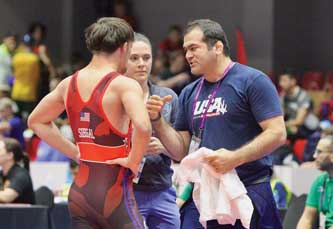
MA: We moved to the U.S. in 2020. Currently, I am the head coach at the West Coast Regional Training Center at California Baptist University in Riverside. I am also coaching at a private wrestling academy called So Cal Grappling and at Bonita Vista High School in San Diego.
AS: Thank you for your information and the time you have shared with us.
MA: I also thank you for the opportunity you have given me.
Sports Achievements of Mostafa Alizadeh as an Athlete: Winner of a silver medal at the U23 World Championship, Nantes, France (2000); Winner of a bronze medal at the U17 World Championship, Tehran, Iran (1996); 6th place at the U20 World Championship, Sydney, Australia (1999); Winner of a gold medal at the Asian Championship, Tehran, Iran (1999); Three-time champion of Iran; Medalist in eleven international freestyle wrestling tournaments; Member of Iran’s national freestyle wrestling team in over twenty-five international tournaments.
Sports Achievements of Mostafa Alizadeh as a Coach: Coach of the U.S.’s national freestyle wrestling team at the ISF World Games (2024); Coach of Iran’s national junior and youth freestyle wrestling teams in seven editions of the Asian Championships (from 2012 to 2019); Coach of Iran’s national junior and youth wrestling teams in seven editions of the World Championships (from 2012 to 2019); Supervisor of Iran’s national junior freestyle wrestling team (2017 and 2018); Coach and head coach of Iran’s national team in four editions of the World Club Wrestling Championships; Coach of Iran’s national freestyle wrestling team in over 20 international tournaments.