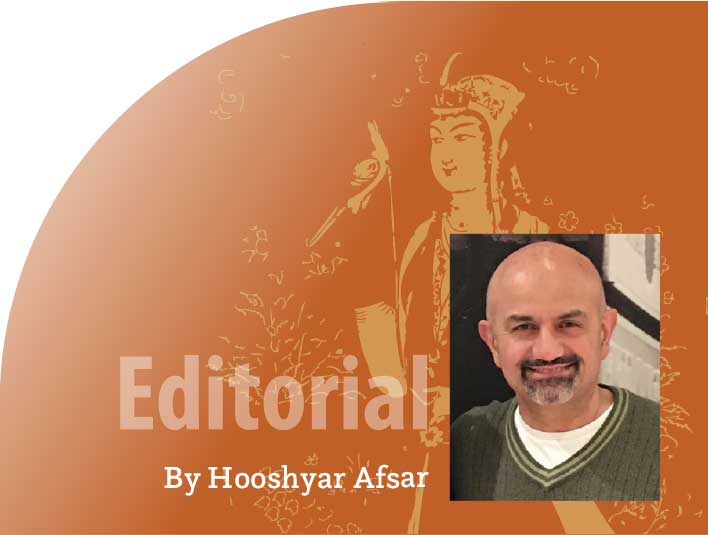
Hooshyar Afsar
By the time I started writing these words, a destructive war had already caused the death of thousands of people in Iran and tens of thousands of Iranians had been injured. Over eighty thousand housing units were destroyed or badly damaged. The war has pushed Iran’s industrial and educational bases years (if not decades) back by doing significant damage to steel mills, petrochemical complexes, oil and gas refineries, bridges, hospitals, universities, schools and more. While opposition or support for the war has shifted from the onset of the war, our community in the United States and the whole Iranian diaspora continues to be divided in unprecedented ways. Multiple polls on the current war by Israel and the U.S. are indicators of the division.
There is no doubt that the people inside Iran are also divided, yet it is much more difficult to assess that division. We don’t have a poll from Iran that has been under U.S. and Israeli bombs and missiles and intensifying government repression, yet it is not difficult to speculate that there is a diminishing group of Iranians inside Iran that support the war on their homeland. After the president of the U.S. made profane remarks on Easter Sunday about the Strait of Hormuz, followed by the genocidal sentence stating that a “whole civilization will die tonight,” the number of people inside Iran volunteering to “defend the homeland” soared to over twenty million. In addition to failing to bring about “regime change” and “democracy” in Iran, the war has resulted in strengthening the Islamic Republic and has caused a “rally around the flag.”
All of this was predictable as aerial bombardment has never resulted in the establishment of democracy and human rights in the history of humanity. Even war with ground troops has not resulted in democratic changes except for Japan and half of Germany at the end of WWII in 1945. This, after over fifty million dead worldwide, including ten million Germans and three million Japanese, plus the complete destruction of Germany and two nuclear bomb attacks against Hiroshima and Nagasaki. The fire bombing of Tokyo had already killed 100,000 people before the U.S. dropped the two nuclear bombs on Japan. While Germany and Japan remain the exceptions, a few commentators on the margins of our community are calling for such destruction to bring “regime change” in Iran.
The worldwide reaction against the genocidal threats against Iran and its whole population—one that sounds horrifyingly of a possible nuclear attack—has already caused a huge uproar in our community. Many people who were hopeful about “regime change” in the beginning days of the war and “precision attacks’ with minimal civilian deaths soon realized that the U.S. and Israel were destroying Iran and there was no real commitment to democracy and human rights.
I ask myself how is it that the Iranian community worldwide has gone through this level of disunity and division that so many people welcome war and destruction of their own place of birth. The primary reason I can come up with is an utmost sense of despair and helplessness. For people inside Iran, decades of repression, plus unbearable economic pressure and uncontrollable inflation, caused a significant group of Iranians to fall for the false “quick” fix through foreign intervention. For the Iranians of the diaspora and, specifically, the Iranian American community, the same sense of despair and helplessness exists, yet the economic pressure is pretty much non-existent and it is only a concern indirectly through family and friends for those who still have them living in Iran.
Building democracy with a system of checks and balances is difficult and requires a strong civil society. Building a strong civil society amid the repression of Islamic Republic is even more difficult and needs long years of patient organizing with resilience. Resorting to war and violence and aligning with foreign forces who have no interest in bringing democracy and human rights in Iran is futile. It is a “quick fix” mirage. These forces have shown in many other parts of the world—including Gaza, Afghanistan, and Iraq—that they have no commitments to democracy and human rights. Even if they had such commitments, they wouldn’t succeed since democracy can only be established by the indigenous people of a country and their democratic institutions.
In the midst of the trauma of war, destruction, and repression, and under the bombardment of social media misinformation and disinformation, our community worldwide needs healing more than any other time. We each have a freedom to choose. I once learned that true choice means freely selecting after all the considerations. We are free to choose compassion, understanding, peace, human rights, democracy, and standing for the unity of our community… and that is what I choose.