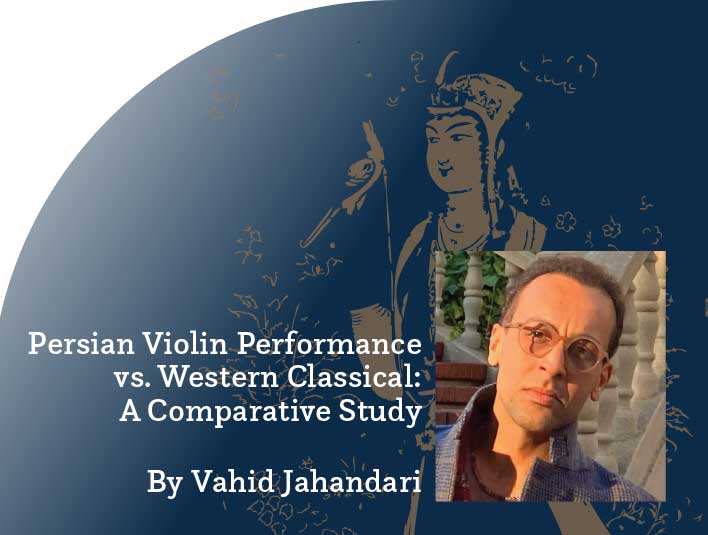
Persian Violin Performance vs. Western Classical: A Comparative Study
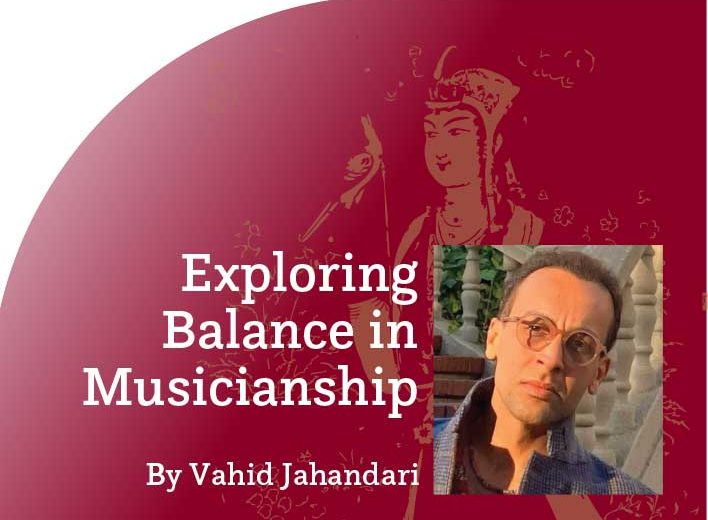
By Vahid Jahandari
Introduction
The violin, though born out of centuries of European craftsmanship and aesthetic development, has transcended its origins to become a truly global instrument. In Iran, it has assumed a distinctly Persian identity, reshaped through the modal system of Dastgāh and integrated into a long tradition of improvisation, ornamentation, and microtonal nuance. While Western classical violin performance is deeply tied to written notation, harmonic progression, and formal structures, Persian violin emphasizes spontaneity, subtle intonation, and melodic exploration. These two traditions, though performed on the same instrument, diverge in nearly every dimension—time signatures, rhythmic frameworks, scales and modal systems, as well as bowing and fingering techniques.
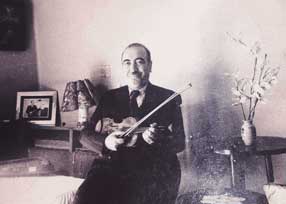
In my recent article for Peyk, I reflected on the aesthetic dimensions and challenges of performing Persian-style violin. Here, I aim to extend that exploration into a more direct comparison between Persian and Western classical approaches and reveal the aesthetic logics that underpin each style. By examining the metric regularity of Western classical repertoire alongside the flexible rhythmic cycles of Persian music, comparing the Western tempered scale with the microtonal intervals of Persian Dastgāh, and contrasting the technical demands of each—whether the virtuosic passages of J. S. Bach or the intricate ornamentation of Abolhasan Saba—we gain insight into how the violin becomes a vessel for distinct cultural expressions. My own background allows me to approach this comparison with both analytical rigor and lived experience. The goal is not to claim superiority for one system over the other, but to illuminate how divergent approaches to rhythm, scale, and technique can expand our understanding of the violin’s expressive possibilities across cultures.
Metric Regularity vs. Flexible Cycles
In Western classical music, rhythm is anchored by clearly defined time signatures such as 2/4, 3/4, or 4/4. These meters establish a framework of regularity, shaping both the internal structure of a piece and the coordination of ensemble performance. Consistent tempo and rhythmic precision are essential, particularly in polyphonic works such as J. S. Bach’s Chaconne from the Partita No. 2 in D minor, where overlapping voices and harmonies depend on a steady metric pulse to remain intelligible. Rhythm here is not only a matter of pulse but also a vehicle for supporting harmonic progression, thematic development, and large-scale form. From the steady beat of a Bach fugue to the dance-like patterns of a waltz, metric clarity is a fundamental feature of Western violin performance.
By contrast, Persian violin performance treats rhythm with greater elasticity, often moving between free-rhythm passages and metrically-defined cycles. Even in sections with a clear metric framework, the sense of time remains flexible: phrases may subtly accelerate or decelerate, creating a natural ebb and flow while still adhering to the indicated tempo. The Avaz sections of a Dastgāh emphasize breath-like phrasing and expressive timing, allowing the performer to linger, stretch, or compress rhythm for heightened emotional effect. More structured forms, such as Chaharmezrab, introduce rhythmic drive, but even here, nuance and flexibility take precedence over metronomic precision. This fluidity presents both opportunities and challenges for performers: while it allows for deep melodic expressivity, it requires sensitivity to cultural aesthetics and improvisational flow. For musicians accustomed to the metric regularity of Western classical music, adapting to Persian rhythmic practices demands not only technical adjustment but also a shift in interpretive mindset.
Tempered Tuning vs. Microtonality
In Western classical music, scales are based on equal temperament, dividing the octave into twelve equally spaced semitones. This system allows for chordal mobility, modulation between keys, and consistent intonation across instruments. Major and minor scales, along with modes such as Dorian or Phrygian, provide the foundational building blocks for melody and harmony. Violinists trained in this tradition rely on precise intervals and consistent pitch relationships, which facilitate both polyphony and chordal structures. The tempered system’s predictability ensures that notes and chords retain the same harmonic relationships regardless of key, making modulation and complex counterpoint possible, as exemplified in the works of Mozart and Beethoven.
In violin solo works by Bach, particularly across the three books of Sonatas and Partitas (BWV 1001–1006), modulation plays a central role: thematic material moves through multiple keys, often employing secondary dominants, sequences, and pivot chords to create contrast, tension, and harmonic narrative. By contrast, in Persian violin repertoire—whether the works of Saba or Ruhollah Khaleghi—modulation is exceedingly rare and occurs only as brief transient pitch shifts; the emphasis is on elaborating a single melodic motif within a fixed Dastgāh or mode, developing it through ornamentation, microtonal inflections, and rhythmic variation rather than traversing multiple tonal centers.
Persian music revolves around the Dastgāh system, a collection of modal frameworks that organize pitches, melodic motifs, and ornamentation. Each contains specific microtonal intervals that do not align with the Western tempered scale. The Radif, the canonical repertoire of Persian music, preserves these modal patterns through centuries of oral and written tradition, providing an expressive guide for improvisation. Unlike equal temperament, Persian microtones allow subtle pitch inflections that convey emotional nuance, giving performers latitude to ornament, bend, and inflect notes according to the aesthetics of the mode. For violinists navigating both traditions, this means adjusting finger placement, ear training, and intonation strategies to accommodate microtonal intervals that fall between the familiar Western semitones.
Ornamentation, Bowing, and Fingering
In Western classical violin performance, technique is highly codified, with bowing, fingering, and articulation serving both precision and expressive intent. Bow strokes—legato, staccato, spiccato, and others—are executed according to the phrasing, dynamics, and stylistic conventions of the piece. Fingering patterns are often optimized for smooth transitions and technical efficiency, while ornamentation, when present, is typically written or stylistically standardized, as in Baroque trills, mordents, or appoggiaturas. In polyphonic passages, the interplay between bowing and fingering ensures clarity of multiple voices, and dynamic control is often achieved through subtle variations in bow speed, pressure, and placement on the string.
By contrast, Persian violin performance employs bowing techniques that are fundamentally different, shaped by the expressive demands of the Dastgāh system. Bowing is often more flexible and nuanced, with rapid changes in pressure, direction, and contact point to articulate microtonal inflections, ornaments, and subtle slides (tahrir or glissandi). The bow may linger or oscillate on a single note to enhance emotional expression, and multiple strings can be engaged simultaneously—as in celebrated pieces such as Caravan (کاروان) and Zange Shotor (زنگ شتر)—to create resonant drones or sympathetic harmonies.
Fingering in Persian music prioritizes melodic contour and microtonal precision over ergonomic efficiency, requiring careful ear-guided adjustment rather than reliance on fixed patterns. Ornamentation is central, improvised, and highly varied, serving for personal expression rather than strict adherence to notation. Together, these technical differences highlight how the same instrument can embody two profoundly distinct aesthetic worlds.
Notation vs. Improvisation
In Western classical music, interpretation is largely guided by written notation, which specifies pitch, rhythm, dynamics, and articulation with a high degree of precision. Performers spend years mastering the technical and stylistic conventions embedded in scores, striving to realize the composer’s intentions faithfully. While there is room for personal expression through phrasing, tempo rubato, and subtle dynamics, the general tendency has remained remarkably consistent for centuries: performers interpret within the framework of the score, and deviations from the notated material are the exception rather than the rule. Even with the rise of contemporary and avant-garde composers since the mid-twentieth century, who have encouraged experimental approaches to rhythm, timbre, and extended techniques, the overall aesthetic of Western classical performance continues to prioritize fidelity to notation and structural coherence.
By contrast, Persian violin performance is rooted in improvisation and oral tradition, where the Radif serves as a flexible guide rather than a strict script. Within each Dastgāh, performers make real-time decisions about ornamentation, phrasing, and melodic development, responding to both the emotional content of the music and the interaction with other musicians. This improvisatory approach allows for infinite variation and personal expression, and it has historically defined the aesthetic of Persian music. Contemporary Persian composers may also push these boundaries further, blending traditional practice with modern techniques, yet the core principle remains the prioritization of spontaneous, expressive interpretation over rigid adherence to notation. The contrast between these two systems—notation-centered versus improvisation-centered—highlights how culture and history shape not only technical practice but also the very conception of musical expression on the violin.
The Violin as a Global Instrument
In Western classical tradition, the violin has been embedded within a framework of harmonic development, formal structures, and standardized performance practices, reflecting centuries of European musical thought. Its sound and technique are shaped by an aesthetic that values clarity, balance, and fidelity to the score, with the instrument serving both virtuosic display and ensemble integration. This long-standing tradition has created a shared vocabulary across generations and geographies, allowing performers and audiences to engage with the violin in ways that are widely recognized and codified.
In Persian music, the violin has been absorbed into the modal system of Dastgāh and the rich repertoire of the Radif, transforming it into a medium for melodic expression, microtonal inflection, and improvisation. Here, the violin reflects aesthetic priorities that differ from the Western canon: emotional depth, melodic ornamentation, and subtle interaction with rhythmic and modal structures take precedence over harmonic progression or strict metric regularity. Persian violinists navigate both inherited tradition and personal interpretation, making the instrument a site of cultural dialogue and creative flexibility. The violin’s adaptability to such divergent musical worlds underscores its role as a truly global instrument, capable of embodying multiple cultural identities while inspiring cross-cultural exchange and innovation.
The violin’s global significance extends beyond cultural adaptation to how performers perceive, produce, and correct sound. Unlike fretted instruments like the classical guitar, the violin demands continuous auditory monitoring and fine motor adjustments, creating an interactive feedback loop between ear and hand. Violinists engage both fast, medial frontal error-correction processes and slower, parietal-based monitoring systems that accumulate sensory evidence before triggering adjustments, highlighting the instrument’s cognitive and motor demands. Its fretless design and expressive range allow navigation of complex intonation, ornamentation, and improvisation while engaging sophisticated error-detection mechanisms. The violin’s adaptability reflects not just cultural or aesthetic versatility but also real-time, embodied decision-making, whether negotiating Bach’s rapid modulations, Dastgāh’s microtones, or contemporary pitch manipulations. It thus exemplifies a convergence of tradition, innovation, and neurocognitive skill.
Insights from Comparative Violin Practice
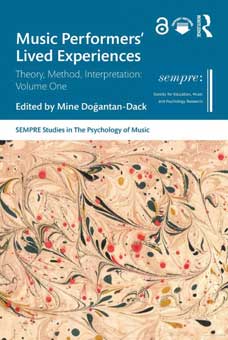
Ultimately, examining Persian and Western classical violin performance through the lenses of rhythm, modality, technique, and interpretation highlights not only the technical and aesthetic distinctions between these traditions, but also the deeply human experiences of music-making. In line with the aims of Music Performers’ Lived Experiences, such comparative study contributes to a more performer-centered understanding of music, emphasizing how violinists navigate cultural norms, historical contexts, and embodied practices while interacting with instruments, repertoire, and fellow musicians. By attending to ornamentation, improvisation, microtonality, metric flexibility, and the expressive possibilities of each tradition, we gain insight into the rich, nuanced, and personally meaningful experiences of performers. This perspective “humanizes” violin performance, foregrounding the emotional labor, interpretive agency, and sensory engagement that define the lifeworld of musicians.
Vahid Jahandari, award-winning composer, performer, and educator, specializes in ElectroAcoustic and world music. His works range from acoustic to electronic, earning top prizes, festival showcases, and commissions.