
Supreme Court and the Constitution
Separation of Powers Series
Part 4
By Hooshyar Afsar
 Introduction
An independent judiciary is one of the pillars of a democratic republic and is essential to safeguarding democracy. Independence is usually achieved by certain selection mechanisms to make sure that a court system, all the way to the highest court(s) of the land—the Supreme Court of the United States (SCOTUS) in the case of our country—is, for the most part, free of political influence and its decisions reflect the laws of the land. An independent judiciary in a democracy does not guarantee democracy, yet it is another check on authoritarianism in a system of checks and balances that are part and parcel of separation of powers. While it is not possible to provide even a brief history of the SCOTUS in the limited pages here, I will attempt to highlight how the Court’s decisions relate to our community.
Article III of the Constitution: The Judiciary
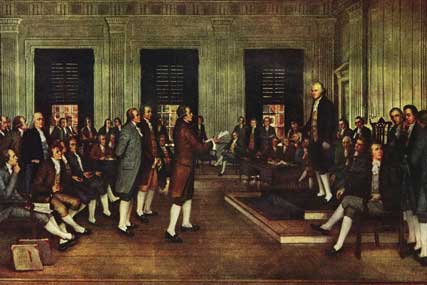
The original 1787 U.S. Constitution, before any amendments were ratified, had seven articles. Article III is dedicated to the judiciary and is the shortest one. Section 1 of Article III states that “The Judicial Power of the United States shall be vested in one supreme Court and in such inferior Courts as the congress from time to time ordain and establish.” Section 1 also states that the judges of the SCOTUS and the inferior courts (i.e., federal courts) “Shall hold their offices during good Behavior,” meaning that they are not subject to any term limits. The power to appoint SCOTUS justices is given to the president, but does require approval of the Senate.
What are the two most important points one could derive from the short content of Article III? The first one is that the number of Supreme Court justices could be determined by Congress. Currently, there are nine justices of the Supreme Court, yet the Judiciary Act of 1789 set the number of the first SCOTUS to six. By acts of Congress, that number went down to five after a few years, then back to six, then to seven in 1807, then increased to nine in 1837 and ten in 1863, then to seven via death/retirement in an 1866 act, and finally back to nine in the Circuit Court Act of 1869.
Surprisingly, the second point is about a supreme power that is neither in Article III nor in any other parts of the Constitution, namely a concept called “judicial review” in legal lingo. Judicial review is the power to declare whether any laws passed by Congress or the states are in conformance with the U.S. Constitution, in other words, the “constitutionality” of such laws. How was this supreme power given to the SCOTUS?
The Marshall Court and Judicial Review
John Marshall was the fourth chief justice of the SCOTUS and, in addition to being the longest-serving chief justice (1801 to 1835), he was one of the most—if not the most—influential chief justices of the SCOTUS. Perhaps the most important case that completely transformed the role of the SCOTUS in the American Republic was Marbury vs. Madison. Before discussing the case, let’s look at the historical and political context.
In the presidential elections of 1802, incumbent president John Adams lost to Thomas Jefferson. Just before leaving office, Adams commissioned dozens of new federal judges to pack those courts with Federalists, i.e., members of his own party. It’s important to note that packing the courts was part and parcel of the political rivalries between the Federalists (Adams/Hamilton) and Democratic Republicans (Jefferson/Madison) over 220 years ago; what we observe today in judicial jockeying is definitely not new. For more on the early political battles of the Republic, see my second article in this series. [1]
Adams’ new judicial commissions were supposed to be delivered to their recipients before Jefferson’s inauguration in March 1803, but a number of them were not delivered on time. Notably, one of them belonged to William Marbury of Maryland. Once Jefferson was sworn in as president, he appointed James Madison as his new Secretary of State, and the job of delivering Adams’ undelivered judicial commissions fell to Madison. However, Madison refused to deliver them as they would have installed members of an opposing political party in the courts. Aggrieved, Marbury sued and the case went before the Supreme Court.
Supreme Court Chief Justice John Marshall, a devout Federalist who had been appointed by President Adams, surprisingly ruled in favor of President Jefferson’s Secretary of State—the named party Madison—and basically argued that such law requiring the delivery of the undelivered commissions did not exist in the original Constitution or the amendments up to that point and was therefore rejected. In making such a ruling, Chief Justice Marshall gave President Jefferson and his party a tactical win, but in the process established a legal precedent that gave the Supreme Court the ultimate power of judicial review. This elevated the SCOTUS to a new height of power and relevance with landmark decisions that have significantly impacted democracy and civil rights in the 223 years since.
When I first read about this case several years ago, I thought that this ruling by itself was unconstitutional as Chief Justice Marshall managed to use a decision to give a power to the SCOTUS that was not in the original constitution. Since then I have mulled over the idea and realized that any constitutional democracy needs a constitutional court and—at the time—the void was filled by Marshall’s trickery. In fact, this ruling was later used by pioneers of the idea of “constitutional supreme courts” in the twentieth century that currently exist in Spain, Germany, Austria, South Africa, and many other democracies in the world. It should also be noted that the existence of a supreme constitutional court, in addition to a supreme appellate court that reviews the appeals on the decisions of lower courts, does not automatically guarantee separation of powers and the upholding of democracy. Yet, its existence, along with the other aspects of separation of powers, could further the independence of the judiciary.
The Main Challenge Facing SCOTUS Today
While “packing the court” by political parties that have held the presidency and the Senate majority has existed throughout the history of the United States, the current ideological packing of the SCOTUS after three appointments of justices by Donald Trump in his first term is unprecedented. The current conservative six-to-three majority is here to stay as the amount of time justices are able to serve has been significantly increased due to higher life expectancy and the relative youth of newly appointed justices.
SCOTUS is also facing a credibility issue due to the widening gap between its ideological decisions and how the majority of the American public views the issues at hand. The most clear example of such decisions in recent years was the 2022 overturning of Roe v. Wade and the constitutional right to abortion that is clearly in contradiction to what the majority of Americans think, as poll after poll has demonstrated. In the current political atmosphere, the Supreme Court’s ideological decisions with regards to the extent and reach of the executive power of the presidency are pushing the Court farther away from public opinion. How could this major challenge for American democracy be addressed?
What Reforms are Constitutional and Who Could Do it?
Article III of the U.S. Constitution empowers the Congress of the United States to “establish and ordain” federal courts “inferior” to SCOTUS. Yet Congress also has the power to determine the number of justices on the Supreme Court as it has done many times in the past. While Congress could not set terms for justices, it could establish mechanisms to limit how many justices could be appointed by a president during a four year term. It could also legislate making justices “senior justices” after a certain number of years. The notion of senior justices and senior federal judges already exists. For example, Justice Anthony Kennedy, who resigned during Trump’s first term in 2018, is now a senior justice with certain responsibilities. Justices David Souter and Sandra Day O’Connor, who also resigned, became senior justices. Congress could expand their responsibilities after setting a term. In fact, there is a proposal to limit the active term of all justices to 18 years and the number of justices appointed in every four year presidential term to two in order to create a balance and reduce the political influence of one party. [2]
It’s also important to note that while more drastic reforms—such as complete removal of justices or changing the process of selecting justices for the Supreme Court—would require the lengthy and seeming impossible process of ratifying a constitutional amendment, at the state level, 47 out of 50 state supreme courts have fixed terms and a reselection process for justices and the majority have mandatory retirement ages for state supreme court justices. Only Rhode Island has a lifetime term for its supreme court justices similar to the one for SCOTUS. [3] In a sense, term limits and mandatory retirement ages for justices is part of American democratic tradition.
The Supreme Court and Our Community
SCOTUS has had at least 15 significant rulings directly affecting immigration and immigrant communities. [4] The most recent one is the June 2018 decision in Trump vs. Hawaii allowing the travel ban—also known as the Muslim ban—to be enforced. In the past I have written about how the majority of visa application rejections resulting from this ban belonged to Iranian applicants. In fact, considering its outcome, many believe that the travel ban should have been called the “Iranian Ban.” The original Muslim ban was rescinded by the Biden Administration, yet a new travel ban was again put in place in June 2025 against citizens of 19 countries, including Iran. There are ongoing legal challenges against the current ban, yet considering the 2018 decision of the SCOTUS, the prospects of the SCOTUS accepting to review any of such challenges or ruling against the current travel ban looks grim. A golden opportunity to reform the SCOTUS was lost in 2021, yet the political tides are turning as they have done so in the past. For example, since the SCOTUS ban on abortion in 2022, twelve states—including solidly Republican states such as Kansas, Missouri, Ohio and Montana—have voted to add abortion rights to their state constitutions. American voters are showing a clear tendency toward change. Our community could and should be part of this change to safeguard and expand American democracy and protect our fundamental rights in the months and years to come.
__________________________________________________
References:
[1]- https://peykmagazine.com/en/2025/09/08/separation-of-powers-series-part-2#:~:text=The%20context%20of,art%20of%20compromise
[2]- https://www.brennancenter.org/our-work/analysis-opinion/supreme-court-term-limits-are-path-more-accountable-high-court
[3]- https://www.brennancenter.org/our-work/analysis-opinion/life-tenure-rarity-state-supreme-courts#:~:text=Today%2C%2047%20states%20provide%20for,two%20impose%20an%20age%20limit
[4]- https://immigrationhistory.org/timeline/