
The Hidden Harmony in the Art and Architecture of Fars: A Legacy of Balance and Splendor
Ali Bazmandegan
Fars has always been an astonishing land for me, a vast expanse of geographical and spiritual territory full of discoveries and hidden beauty. Every time I looked at the art of this region, I felt that history and beauty were intertwined in a way that transcends mere chronology; each corner told a story of a civilization that refused to let aesthetic brilliance be separated from structural necessity. Over the years of observation and personal experience, I realized that a substantial part of Iranian art flows through this region, and every piece of its heritage offers a window into the hidden harmony of Persian artistry.
At first glance, the harmony of Fars art may seem simple, but the deeper I observe, the more intricate and delicate it becomes. Architecture, carpets, handicrafts, and the interplay of light and shadow on various surfaces all exist in precise coordination. This harmony does not just please the eye; it also evokes a profound inner balance and serenity. Fars art shows that true beauty lies in alignment, meticulousness, and the subtle detail that connects the human experience to the cosmic order.
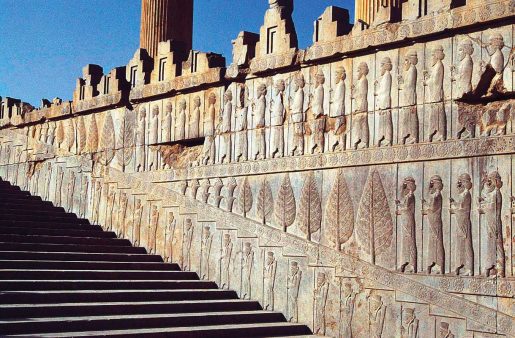
Persepolis: The Geometric Pulse of an Empire
On the vast, windswept plains of Marvdasht stands Persepolis (Takht-e Jamshid). To understand its harmony, one must look beyond the ruins and into the mathematical grid upon which it was built. The architects of the Achaemenid era did not merely stack stones; they choreographed space according to the principles of Asha (Truth and Order). The terrace, an immense platform of 125,000 square meters, was carved partly out of the “Mountain of Mercy” (Kuh-e Rahmat), creating a literal foundation for an empire that sought to mirror the heavens.
The technical brilliance of Persepolis lies in its “Anathyrosis” jointing technique. Stone blocks were smoothed only at the edges to ensure a perfect fit, while the centers were left slightly concave. This ensured that the weight was distributed solely on the outer edges, preventing the stones from cracking under their own immense pressure. Furthermore, the use of iron and lead clamps—shaped like bow ties—provided a flexible skeleton. When an earthquake struck, these clamps allowed the stones to shift slightly and then return to their original positions. This is the first layer of hidden harmony: the marriage of brutal weight and delicate flexibility.
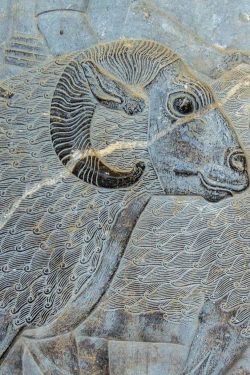
The bas-reliefs on the Apadana staircases are a masterpiece of social harmony. Twenty-three delegations are depicted, each wearing their national dress and carrying local gifts. There is a rhythmic repetition in the figures—the way a Median guard touches the shoulder of a Persian officer—that suggests a world of mutual respect and diplomatic poise. The lotus flower, appearing hundreds of times, acts as a visual “metronome,” keeping the timing of the entire architectural symphony. In Persepolis, the “hidden harmony” is the realization that a global empire can only be sustained by a shared commitment to aesthetic and moral perfection.
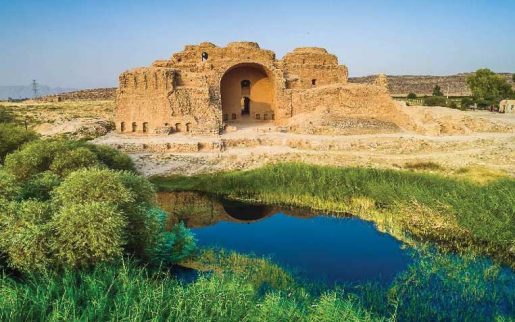
The Palace of Ardashir: The Genesis of the Persian Dome
The journey of Fars architecture leads us to the rugged landscapes of Firuzabad, where the Palace of Ardashir Pápakán stands as a monument to radical structural innovation. This is where the Persian architectural DNA shifted from the straight, post-and-lintel lines of the Achaemenids to the magnificent, soaring curves of the Sassanid era.
The most significant contribution of this palace to world architecture is the Squinch (Filpoosh). Before this invention, builders struggled with the “transition problem” of how to place a circular, heavy dome on a square room. By building arched squinches across the corners, the architects created an octagonal bridge that allowed the circle to rest upon the square. This was not just a structural solution; it was a cosmic metaphor. The square represented the stable, four-cornered material earth, while the dome represented the infinite, perfect sphere of the heavens.
This “hidden harmony” between the terrestrial and the celestial became the blueprint for almost all subsequent Persian and Islamic architecture, influencing the world from the Taj Mahal to the cathedrals of Europe.
The palace’s location near a natural “Khooniy” (artesian spring) highlights the ecological harmony inherent in Fars. The building frames the landscape, mirrored in the clear water of the spring. The use of “Sarooj”—a traditional water-resistant mortar made of lime, sand, and organic fibers—allowed the Sassanid architects to build massive, echoing vaults that were designed as much for their acoustic resonance as for their visual majesty. To walk through these halls is to hear the silence of history, amplified by the perfect proportions of the stone.
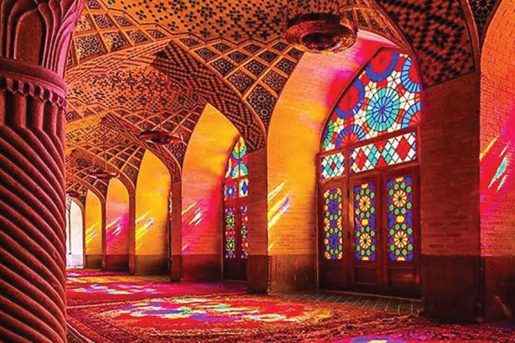
Nasir al-Mulk: The Alchemy of Light and Pigment
Moving into the heart of Shiraz, we encounter the Nasir al-Mulk Mosque, where harmony is no longer found in the weight of stone, but in the weightlessness of light. While most mosques utilize cobalt blue and turquoise to represent the sky, Nasir al-Mulk breaks tradition with its dominant “Gol-behi” (shrimp pink) palette. This choice of color reflects the famous “Rose of Shiraz,” bridging the gap between the sacred interior and the flourishing gardens outside.
The Western Prayer Hall is a masterpiece of “Chromotherapy.” As the morning sun passes through the stained-glass Orsi windows, the white interior is flooded with a spectrum of colors. These colors are not static; they move with the sun’s trajectory, creating a “living architecture.” The tiles, decorated with Shiraz’s signature roses and iris flowers, represent the “Eternal Garden.” In Persian thought, a garden is a piece of heaven brought to earth, and Nasir al-Mulk is a garden made of tile and light.
The “hidden harmony” here is the bridge it builds between the internal and external. The floral patterns on the walls mirror the real gardens outside, while the play of light mirrors the internal enlightenment sought by the soul. The spiraling stone columns, carved from solid monoliths, seem to dissolve into rays of colored light, teaching us that matter is merely a vessel for a higher spiritual energy.
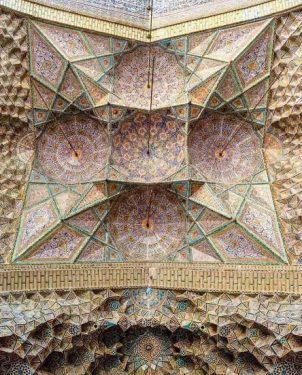
The Qashqai Loom: A Nomadic Map of the Stars
The harmony of Fars is perhaps most vibrantly expressed in the Tribal Carpets of the Qashqai. Unlike city-dwellers who lived in the shadow of monuments, the nomads lived under the open canopy of the stars. Their carpets are “Zehni-baaf” (woven from memory), a process that defies modern industrial logic and emphasizes a direct connection between the heart and the hand.
The weaver begins with no map, only a rhythmic song or a mental image passed down through generations. The motifs—the “Heibatlu” medallions, the stylized “Boteh,” and the guardian animals—are symbols of a life lived in motion. A specific bird motif might represent a mountain pass, while a geometric star might represent the constellation used for navigation during the summer migration.
The colors are a chemical harmony of the earth. Deep reds are fermented from madder roots, yellows from vine leaves, and greens from pomegranate rinds. Because the wool is shorn from sheep that drink from different mountain springs, the dye takes differently to each batch, creating “Abrash” (natural color variations). This is the “hidden harmony” of imperfection—a reminder that in the natural world, true beauty lies in the subtle variations that prove a thing was made by a living hand, not a machine.
Khatam and Qalam-zani: The Geometry of the Infinite
The handicrafts of Shiraz, specifically Khatam-kari and Qalam-zani, represent the pinnacle of Persian precision and the mastery over the minute. Khatam-kari is the art of encrustation, where thousands of tiny rods of wood (ebony, orange, teak), bone (camel), and metal (brass) are bonded to form star-shaped geometric patterns. In a single Khatam frame, there may be over a million individual pieces, each no larger than a grain of rice. This is the “micro-harmony” of Fars. It requires the artisan to embody the virtue of Sabr (patience), working for months on a single surface. The resulting patterns are fractal in nature; the closer you look, the more detail you find, mirroring the infinite complexity of the universe. This is the triumph of human discipline over raw material.
Similarly, in Qalam-zani (metal engraving), the Shiraz school is known for its “flat” style. While other regions might gouge the metal to create deep shadows, the Shirazi artist grazes it. The scenes—often of polo matches, hunting, or the court of the ancient kings—are executed with the delicacy of a miniature painting. The harmony here is the reconciliation of the hard (the metal) and the soft (the artist’s touch), a demonstration that even the most stubborn materials can be made to sing when handled with grace.
The Persian Garden: Living Geometry
To complete the architectural harmony of Fars, one must step into the Persian Garden (Baq-e Irani), specifically iconic sites like Baq-e Eram or Baq-e Delgosha. The garden in Fars is not a mere collection of flora; it is a sophisticated terrestrial reflection of the celestial paradise.
The structural harmony is defined by the “Chahar-Baq” (Four Gardens) layout—a quadrilateral design divided by water channels. This geometry is a masterclass in hydraulic engineering. In an arid landscape, the Fars artisan harnessed the power of gravity and Qanats (underground aqueducts) to ensure a constant flow of water. The sound of water rippling over stone turquoise tiles provides an acoustic balance to the visual stillness of the tall cypress trees.
The “Hidden Harmony” here is the dialogue between the “Soft-scape” (the living trees) and the “Hard-scape” (the stone pavilions). The pavilion, or Koushk, is always placed at the intersection of the water axes, serving as the focal point where human creativity meets natural beauty. These gardens are the source of the very motifs—the roses and nightingales—that we see in the region’s tiles, rugs, and engravings.The Poetic Resonance: Hafez, Saadi, and the Shiraz School
Finally, the “hidden harmony” of Fars is anchored in its literature. The poems of Hafez and Saadi are the atmospheric pressure of the region. The rhythm (Aruz) of a Hafez ghazal is identical to the rhythmic spacing of the arches in a Shirazi garden or the repetitive motifs in a Khatam box.
This literary harmony influenced the Shiraz School of Miniature Painting. In these paintings, there is no single perspective; the eye is invited to wander through the garden, the palace, and the heavens all at once. The colors—vibrant oranges, deep indigos, and emerald greens—are the same colors found in the tiles of the mosques and the threads of the tribal rugs. In Fars, the word, the image, and the space are a singular, unified expression of the human condition. The bird (Morgh) chirps toward the rose (Gol), a narrative of the soul’s longing for divine beauty.
Conclusion: The Unified Theory of Fars Art
The hidden harmony in Fars art is a philosophy that has endured for millennia. It views the world not as a collection of disjointed parts, but as a singular, beautiful whole. From the massive, unyielding stones of Persepolis to the delicate, light-filled spaces of Nasir al-Mulk, and from the tribal knots of a nomad’s rug to the microscopic triangles of a Khatam box, a single spirit flows through them all: the pursuit of Tawazun (Balance).
Fars art teaches us that true beauty is not a coincidence; it is the result of centuries of contemplation, artistic discipline, and a deep understanding of the balance between the material and the spiritual. It is a legacy of creativity that remains alive and inspirational, a living current that continues to teach the world how precision, when infused with love and history, creates something truly eternal. Every color, shape, and pattern in this land is a facet of this hidden harmony, revealing a culture that sees the world as a sacred garden, waiting to be understood by the heart.
It is this harmony that makes Fars not just a place on a map, but a destination for the soul.