
Visiting America’s National Parks:
A Legacy to the World and the Next Generation
By Rachel Tait
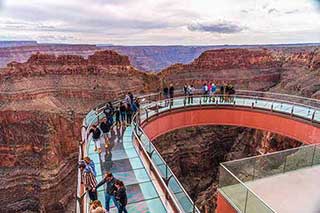
 We walked slowly to the end of the trail, my cell phone on video-mode, wanting to capture the look on my nine-year-old son’s face when he peered over the edge of the Grand Canyon for the first time. My husband and I had prepared him the best we could: the vastness of the canyon might not seem quite real; it might be a little difficult to tell just how big the canyon is from one viewpoint; cloudy conditions might dim colors that would otherwise gleam during a different season or time of day.
But none of that mattered when he stepped up to the railing and gasped. “Wow,” he breathed. “Wow.” Our usually uber-talkative child was reduced to a single word, uttered twice.
Wow, indeed.
We stood there silently for a few moments, taking in the scene alongside scores of other nature-lovers, people who had traveled from distances far and near to experience the sheer joy of witnessing one of our planet’s most impressive wonders. There was no din of heavy traffic nearby, no construction noise, no Walmart or other big box store perched precariously close to the edge to ruin or detract from our experience—just a nicely laid out walkway, some railings and viewpoints, and miles and miles of view.
This peaceful experience would not have been possible without the foresight of visionaries preceding us and those who have worked tirelessly and diligently to maintain it.
The U.S. ’s National Park System
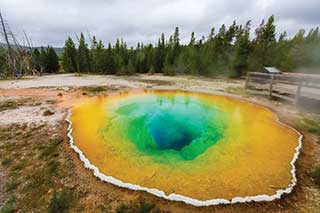
The Grand Canyon is just a small part of one of the most impressive national park systems in the world. America’s first national park—Yellowstone—was set aside “as a public park or pleasuring-ground for the benefit and enjoyment of the people” per an act of Congress in 1872. Not only was Yellowstone America’s first “national” park, it was the world’s first national park, an idea that soon spread to almost one hundred other countries.
In the late 1800s and early 1900s, more national parks and monuments were created in the U.S., though they were managed by various federal departments. Renowned conservationist President Theodore Roosevelt signed the Antiquities Act in 1906, allowing him and his successors the ability to proclaim additional areas within federal lands as national monuments. Later, in 1916, President Woodrow Wilson signed the Organic Act, establishing the National Park Service (NPS) to manage the U.S.’s national parks and monuments, plus those that were yet to be created. Today, the NPS manages more than 400 sites, including national parks, monuments, battlefields, lakeshores, reserves, historical sites, and scenic trails.
Not only does the NPS ably manage the public lands under its care, it generates far more in economic output than the taxpayer monies that fund the system. In 2023, the NPS operated on a $3.3 billion budget, but it produced a total economic impact of $55.6 billion (more than 16 fold), including visitor spending, concessions and lodging, recreation fees, tax revenue, and increased activity in gateway communities that support national park visitation. And it did all that while keeping public lands public.
National Park Hopping: Classic American Road Trips
My family is one of those who have taken serious advantage of the park service. I grew up in San Diego and my family spent countless summer vacations travelling throughout the Western United States, mostly visiting national parks and various state parks. My grandparents invited my mother, sister, and me along for the ride. We would leave for weeks at a time, hauling my grandparents’ 16-foot Terry trailer that somehow miraculously slept five of us rather comfortably. That aluminum can would boil us in the heat of summer, but we were able to get out and experience America’s natural beauty in an affordable way. And the s’mores weren’t bad, either!
My sister and I would hunker down in the backseat of the Suburban, devouring books or listening to our headsets. We’d pass miles and miles of high desert or thick forests, craning our necks to see around the next bend in the road. We played the license plate game to pass the time, which our grandparents used as an opportunity to quiz us about state capitals, much to our chagrin. But we sure did learn them quickly!
Across those many summers, we explored Yosemite, Sequoia, Kings Canyon, Lassen, Death Valley, Redwoods, Crater Lake, Olympic, Mount Rainier, Glacier, Yellowstone, Grand Teton, Rocky Mountain, Capitol Reef, Great Basin, Bryce, Zion, Grand Canyon, Petrified Forest, Carlsbad Canyons, Black Canyon of the Gunnison, and Mesa Verde National Parks, plus we later visited Denali National Park in Alaska and Acadia National Park in Maine. This doesn’t even account for the many national monuments we visited, such as Cabrillo here in San Diego or Devil’s Postpile in the Mammoth, CA, area.
Each park has its own unique scenery and vibe, of course, and I definitely have my favorites. But what was exciting then is what is exciting now—arriving at an area of land, set aside by generations before me, to be preserved and protected for all to enjoy. Entry stations, with friendly greetings from park rangers who patiently answer logistical questions, are always a highlight—a chance to ask questions, take a photo with the name of the park, and marvel at reaching another place so many want to visit. Visitor centers are another favorite stop, usually containing exhibits about the park, overview videos, gear, a chance to purchase the all-important fridge magnet, and other useful information.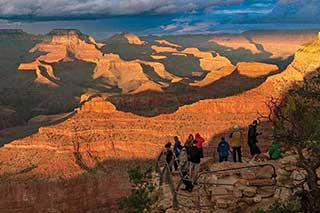
Our Recent National Park Spring Break Adventure
Gone are the days where I enjoy travelling in the heat (and crowds) of summer. In my adult years, I’ve much preferred travelling to our national parks in the fall, winter, and spring seasons. Crowds are generally fewer and temperatures lower. Some roads may be inaccessible, some amenities may not be open, but there is a better tradeoff with more access to nature and fewer lines.
During the COVID-19 pandemic, our first travel away from home was to Yosemite in April 2021. My husband constantly pointed out how few people there were and how we hardly ever had to wait for anyone to move so we could take family photos in front of sights that had historically been thronged with crowds. We knew it was a once-in-a-lifetime experience and it certainly was; last year, in April 2024, we went back to Yosemite and experienced what felt like record numbers of visitors. But it was also gratifying knowing that so many other people were able to enjoy a place we love so much.
For spring break this year, we wanted to break out of the Yosemite routine and show our son something new. So, we planned an almost 1,500-mile loop from San Diego to the Grand Canyon, curving around its eastern border and back northwest to Zion National Park, before heading back home. In seven days, we experienced Prescott, AZ; Montezuma Castle National Monument (featuring a five-story cliff dwelling constructed about 1,000 years ago by native people); the beautiful red rocks of Sedona, AZ; Meteor Crater, AZ (the best-preserved impact crater on the planet, a trip highlight for our space-curious family); Grand Canyon National Park in Arizona; the unbelievable sight of Horseshoe Bend, AZ (where the Colorado River turns back on itself and creates a stunning horseshoe-shaped canyon); Antelope Canyon on Navajo Nation in Arizona (truly one of the most gorgeous and fascinating sights we’ve ever experienced); Lake Powell and Glen Canyon Dam, AZ; the Grand Staircase-Escalante National Monument nature preserve in Utah (where he hiked the Toadstool Hoodoos trail and saw mushroom-shaped rock formations); and the beautiful Zion National Park (where we joined with friends enjoying the same area for spring break and met other San Diego residents doing a similar trip as ours).
In both national parks, we stopped at the visitor center to retrieve a “Junior Ranger” packet for our son to fill out during our day at the park. The activities mostly asked him to pay attention to animals, ecology, the environment, and how humans could help keep the park clean and accessible. Once the packet was done, we returned to the visitor center at the end of the day so our son could discuss his findings with a park ranger, receive a tiny wooden badge, and be sworn in as a junior ranger for that park, promising to help take care of the park for future generations. We were never the only family to do so; we watched tons of other children excitedly hop from one foot to the other while discussing their day with a ranger and pledging to continue the tradition of taking care of our national parks.
Join the Fun and the Legacy
You, too, can have a national park adventure. No matter your age or ability level, the parks are generally accessible and there for you to visit, explore, hike, savor, and enjoy. The National Park Service is present in all fifty states—plus territories—operating at least one park, monument, or other historical or natural site in each location. California has the most national parks and the West is covered with them.
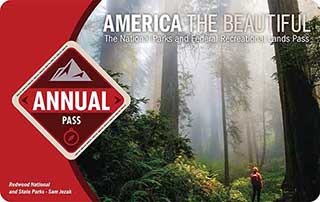
Although the lands are owned by and held open for the public, modest fees still apply for certain sites and entry reservations are sometimes implemented in the more popular parks to deal with expected crowds. Most national parks cost approximately $30 for a 7-day entry, while an annual pass currently costs $80, allowing for unlimited entry to the entire national park system during a 12-month period. Seniors are able to obtain a yearly pass for $20, or upgrade to a lifetime pass for a one-time $80 fee.
Most importantly, though, these lands are our lands. The people’s lands. They have been set aside, protected, and maintained by those who came before us. They are being cared for, right now, by dedicated federal employees, third party contractors, work-study workers, volunteers, and even the youngest among us (those excited junior rangers) for our benefit and so that they may be protected and loved by those who come after us. Let’s show them—and those who are in charge of them—how important they are by visiting and enjoying them.