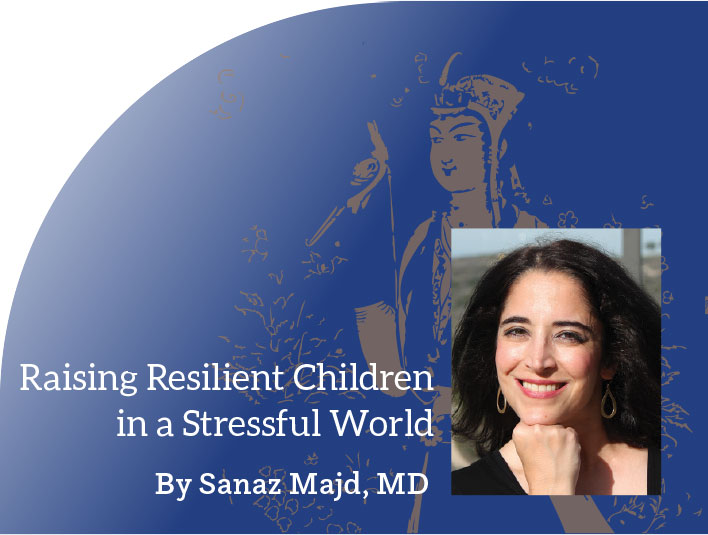
Raising Resilient Children in a Stressful World
By Sanaz Majd, MD
Growing up in a household with four girls (bless my parents), raising two children of my own who are now teenagers, and witnessing friends, family members, and fellow ISSD parents in the midst of raising their children, I can confidently say that parenting is no small feat.
On Sunday mornings at ISSD, as our children sit in class reciting the Persian alphabet and practicing their Nowruz songs, parents gather around the bench tables. This brief window of quiet becomes a space to exhale. We vent, exchange notes, and commiserate over some of the most stressful moments of parenthood. Much of the conversation revolves around experiences that are, in truth, a normal part of growth and development: children who refuse to pick up after themselves, those who push boundaries and resist authority, or teenagers navigating identity formation—rejecting their parents one moment, while clinging tightly the next.
To a large extent, these challenges are a rite of passage of sorts, part of the unspoken contract of raising children. Anyone who claims parenting is smooth sailing from birth to adulthood is not being entirely honest. Even the most easygoing, well-adjusted children will present moments of difficulty. Some turbulence is inevitable. It is simply part of growing up.
That said, not all stress in childhood is benign. Certain children are more vulnerable to psychological stress and may experience it more intensely. This heightened sensitivity can stem from temperament and genetics, making some children more physiologically reactive to stress. Others may be affected by environmental factors such as family conflict, the loss of a loved one, chronic medical illness, financial strain, or exposure to trauma. But more often than not, it is a combination of both genetics and environment.
So what can parents do to help protect their children from the cumulative effects of stress? How can we support them in processing the broader world while also managing the more immediate stressors of home, school, and social life? Short of hiding them under a rock for 18 years, the most effective approach is to equip ourselves with practical tools that foster emotional resilience.
Hold Honest, Developmentally Appropriate Conversations
Withholding information from children is rarely effective… and often counterproductive. Children are perceptive; they sense tension, overhear fragments of conversations, and pick up on emotional cues long before we think they do. In today’s digital age, they are also more technologically savvy than previous generations, with unprecedented access to information through the media and internet.
Shielding children entirely from the realities of the world does not protect them; it simply delays their exposure. Eventually, the information surfaces, often without the context or reassurance that parents are best positioned to provide. Instead, we can support our children by addressing difficult topics honestly, using words that match their developmental stage.
For example, when discussing political unrest or the profound suffering of people in Iran, the approach should differ based on a child’s age. With a 7 year-old, a simple, reassuring explanation may be appropriate: “There are a lot of people in Iran who are very sad and angry because they want to be treated fairly. Some people are trying to make things better, and many families are hurting.”
With a 14 year-old, more detail can be offered, along with space for discussion and questions: “There has been widespread violence and loss of life as people protest for basic human rights. The government has restricted communication, and many families are grieving. It’s heartbreaking, but it’s also important to recognize the bravery of those who are speaking out.”
With that in mind, it’s essential that we regulate our own emotions and approach these sensitive conversations from a calm, grounded place. Children are highly attuned to parental tone and emotional state, and they often internalize what they observe. Speaking from a place of composure helps them process difficult information without adding to their stress or anxiety. This means avoiding profanity, expressions of anger, or language rooted in violence or hatred, and instead modeling thoughtful, measured responses to challenging topics.
When parents initiate these conversations, children learn that they can come to us with questions, fears, and confusion. If we avoid these topics, children will still learn about them… often from sources that may misrepresent or lack emotional sensitivity. Hearing difficult truths first from a trusted adult allows children to feel safer and grounded as they try to make sense of the world.
Therapy and Cognitive Behavioral Therapy (CBT)
For some children, additional support is needed to effectively process stress and emotional challenges. Therapy can be an invaluable resource, offering children a safe, structured space to explore feelings and develop coping strategies.
In the U.S., many insurance plans allow parents to self-refer without a doctor’s order. Doctors can still be helpful in providing referrals or recommendations, but families can also directly seek a licensed therapist within their insurance network. Therapy is now offered both in person and via telehealth, allowing families to choose the format that best suits their child’s needs.
Among therapeutic approaches, Cognitive Behavioral Therapy (CBT) is one of the most well-researched and effective treatments for children and adolescents experiencing stress, anxiety, or mood related concerns. The American Academy of Child and Adolescent Psychiatry recommends CBT as a first-line treatment for mild to moderate anxiety in children.
CBT typically involves 12 to 20 structured sessions and focuses on helping children identify unhelpful thought patterns, understand the connection between thoughts, feelings, and behaviors, and develop healthier ways of responding to stress. Techniques often include cognitive restructuring, gradual exposure to feared situations, relaxation training, and practice assignments outside of sessions.
When introduced early, CBT can provide children with lifelong tools for emotional regulation, problem-solving, and resilience.
Breathing and Relaxation Techniques
Simple breathing and relaxation exercises can be remarkably effective in helping children regulate their nervous systems, particularly during moments of heightened stress or emotional overwhelm.
For Younger Children
• Balloon Breathing: Encourage the child to place a hand on their belly and imagine blowing up a balloon as they inhale, then slowly letting the air out as they exhale.
• Five-Finger Breathing: The child traces each finger on one hand while breathing in and out slowly, creating a visual and tactile rhythm.
• Bubble Breathing: Slow, controlled breaths as if blowing bubbles, gentle enough to keep the bubbles from popping.
For Older Children and Teens
• Box Breathing: Inhale for four counts, hold for four, exhale for four, and hold again for four.
• 4-7-8 Breathing: Inhale for four seconds, hold for seven, and exhale slowly for eight.
• Progressive Muscle Relaxation: Gradually tensing and releasing muscle groups to reduce physical tension.
Practicing these techniques during calm moments, not just during crises, helps children access them more easily when stress arises.
Mindfulness
Mindfulness involves paying purposeful attention to the present moment—thoughts, emotions, and bodily sensations. Rather than dwelling on the past or worrying about the future, mindfulness encourages awareness of what is happening right now, engaging all the senses—sight, sound, touch, taste, and smell.
For children, mindfulness can strengthen self-awareness, emotional regulation, and attention. Research suggests that mindfulness-based practices in children may reduce anxiety, improve focus, and enhance emotional resilience when taught in age-appropriate ways.
Mindfulness does not require long periods of silent meditation. For younger children, it may look like noticing the feeling of their feet on the ground, listening quietly for surrounding sounds, or slowly eating a snack while paying attention to taste and texture. Older children and teens may benefit from guided meditations, mindful breathing, or journaling.
Local libraries often carry excellent books on mindfulness and may host free classes. Institutions such as UC San Diego also offer mindfulness courses tailored to both adults and children (see references below). In a fast-paced, overstimulated world, mindfulness provides a counterbalance, teaching children how to pause, reflect, and reconnect with themselves.
Predictable Routines
Children thrive on predictability. Even when they protest routines, structure provides a sense of safety and security that supports emotional regulation. Consistent routines reduce uncertainty, helping children know what to expect and what is expected of them.
Sleep Routines
Establishing consistent bedtimes and wake times (even on weekends) is critical for physical growth and overall mental health. Adequate sleep is foundational to a child’s ability to cope with stress.
Recommended nightly sleep by age:
• Ages 1–2: 11–14 hours (plus naps)
• Ages 3–5: 10–13 hours (often still including naps)
• Ages 6–12: 9–12 hours
• Ages 13–18: 8–10 hours
Limiting screen use one to two hours before bedtime, keeping phones out of bedrooms overnight, and avoiding televisions in sleeping areas can significantly improve sleep quality.
Routine Mealtimes and Family Dinners
Regular meal schedules provide both nutritional and emotional benefits. Family meals, in particular, offer an opportunity for connection and conversation. Studies have associated shared family meals with improved emotional well-being, academic outcomes, and reduced risk behaviors in adolescents.
Even a few shared meals per week can foster a sense of belonging and stability.
Calm-Down Corners
A calm-down corner is a designated space where children can retreat when they feel physically tired or emotionally disrupted. This is not a punishment area, but rather a supportive environment for self-soothing.
A calm-down corner might include soft pillows, comforting toys, books, coloring supplies, or sensory tools. Some children benefit from noise-canceling headphones or soft music to reduce sensory overload. The goal is to provide a space where children can reset and regain emotional balance at their own pace.
Creative Outlets
Creative expression allows children to process emotions in nonverbal ways, which can be especially helpful when feelings are difficult to articulate.
Effective outlets include (almost anything but a screen):
• Drawing or coloring emotions
• Play-doh, clay, slime, or putty for tactile stress relief
• Stress balls or fidget toys
• Listening to music or dancing
• Outdoor play and playground time
• Hobbies, sports, and structured activities
Creative outlets encourage self-expression and promote a sense of mastery and joy.
In Closing
Parenting is demanding, and supporting children through stress is an ongoing process rather than a destination. None of the strategies discussed requires perfection. Small, consistent efforts—such as open conversations, predictable routines, mindfulness, and opportunities for creative expression—can have a profound cumulative impact.
By creating a safe, structured, and emotionally responsive environment, parents give children the tools they need to navigate stress and carry these skills forward into adolescence and adulthood. In doing so, we are not shielding them from the world, but preparing them to meet it with confidence and strength.
REFERENCES:
American Family Physicians: https://www.aafp.org/pubs/afp/issues/2022/1200/anxiety-disorders-children-adolescents.html
Journal of the American Academy of Child & Adolescent Psychiatry: https://www.jaacap.org/article/S0890-8567(20)30280-X/fulltext
American Academy of Pediatrics: https://publications.aap.org/pediatrics/article/148/2/e2021052580/179745/Trauma-Informed-Care
UCSD Mindfulness courses: https://cih.ucsd.edu/mindfulness
Free Mindfulness Library: https://www.mindfullivingresources.com/free-resources?utm_source=chatgpt.com
Mindfulness Toolkit: https://www.mindful.org/back-to-school-mindfulness-toolkit-for-parents-kids-and-educators/?utm_source=chatgpt.com
Mindfulness apps: https://www.mindful.org/free-mindfulness-apps-worthy-of-your-attention/?utm_source=chatgpt.com
American Academy of Pediatrics mental health resources for families: https://www.aap.org/en/patient-care/mental-health-initiatives/mental-health-resources-for-families/?utm_source=chatgpt.com