The Healing Spice Cabinet: The Science Behind Saffron, Turmeric, and Cinnamon
By Nazanin Abbaspour, PhD, RD, IFNCP
For centuries, Persian kitchens have been filled with the aroma of saffron-infused rice, golden turmeric stews, and cinnamon-spiced desserts. These spices were not chosen by accident. Our ancestors believed they carried healing properties and modern science is proving them right.
Saffron: The Golden Antidepressant
Saffron, the jewel of Persian cuisine, may also be a jewel of mental health. Multiple clinical trials have shown that just 28–30 mg of saffron per day can significantly reduce symptoms of depression. In the largest trial to date, a 12-week study of 202 adults, saffron supplementation led to meaningful improvement in depression scores, with 72% of participants experiencing clinically significant relief compared to 54% in the placebo group. (1)
Even more remarkable, several head-to-head trials have found saffron to be as effective as common antidepressant medications like fluoxetine (Prozac) and imipramine, but with fewer side effects. A meta-analysis of 12 studies confirmed these findings: saffron was significantly better than placebo and comparable to standard antidepressants for mild to moderate depression. (2,3)
How does it work? Saffron’s active compounds—crocin, crocetin, and safranal—appear to influence serotonin, dopamine, and norepinephrine, the same brain chemicals targeted by prescription antidepressants. These compounds also have powerful antioxidant and anti-inflammatory effects that protect brain cells. (4,5)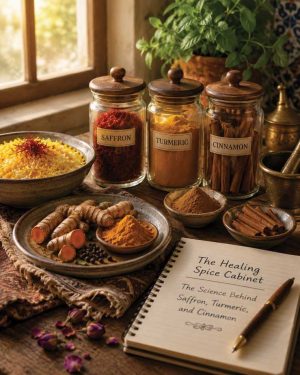
Turmeric: Nature’s Anti-Inflammatory
Turmeric, known as “zardchoobeh” in Farsi, gives many Persian dishes their warm golden color. Its active ingredient, curcumin, has become one of the most studied natural compounds in the world.
A comprehensive analysis of 66 randomized controlled trials found that curcumin supplementation significantly reduces three major markers of inflammation in the body: C-reactive protein, tumor necrosis factor-alpha, and interleukin-6. (6) Chronic inflammation is a driving force behind heart disease, diabetes, arthritis, and even some cancers, making this finding particularly important.
The benefits extend to heart health as well. An umbrella review of 72 clinical trials showed that curcumin can lower LDL (“bad”) cholesterol, reduce triglycerides, and increase HDL (“good”) cholesterol. It also improves blood vessel function and reduces arterial stiffness. (7,8)
One practical note: curcumin is poorly absorbed on its own. Combining it with black pepper (which contains piperine) can increase absorption dramatically. Fortunately, many Persian dishes already pair turmeric with pepper and healthy fats, which further enhance absorption.
Cinnamon: The Blood Sugar Regulator
Cinnamon, or “darchin,” is a staple in Persian teas and sweets. Science now shows it may help regulate blood sugar, a benefit of particular importance given that type 2 diabetes affects a significant portion of the Iranian diaspora community.
A meta-analysis of 28 randomized controlled trials involving over 3,000 patients with type 2 diabetes found that cinnamon supplementation reduced fasting blood sugar by an average of 15 mg/dL, lowered HbA1c by 0.56%, and improved insulin resistance. (9) A crossover trial using continuous glucose monitoring in adults with prediabetes confirmed that cinnamon significantly lowers 24-hour glucose levels and reduces blood sugar spikes after meals. (10)
Beyond blood sugar, a review of 35 clinical trials showed cinnamon also modestly reduces total cholesterol, LDL cholesterol, triglycerides, and blood pressure in patients with metabolic diseases. (11)
A safety note: Ceylon cinnamon (“true cinnamon”) contains far less coumarin, a compound that can affect the liver in large amounts, than the more common cassia variety. If using cinnamon regularly, Ceylon cinnamon is the safer choice. (12)
Your Kitchen Is Your Pharmacy
The next time you prepare tahdig with saffron, stir turmeric into your khoresh, or sprinkle cinnamon into your chai, know that you are doing more than cooking. You are continuing a tradition of healing that stretches back thousands of years, one that modern science now validates.
These spices are not replacements for medical treatment. But as part of a balanced diet, they represent something beautiful: the wisdom of our ancestors, confirmed by the science of today.
Be well, and eat well.
References
(1) Lopresti AL, Smith SJ, Marx W, et al. An examination into the effects of a saffron extract on mood and general wellbeing in adults experiencing low mood. J Nutr. 2025;155(7):2300-2311.
(2) Dai L, Chen L, Wang W. Safety and efficacy of saffron for treating mild to moderate depression: a systematic review and meta-analysis. J Nerv Ment Dis. 2020;208(4):269-276.
(3) Tóth B, Hegyi P, Lantos T, et al. The efficacy of saffron in the treatment of mild to moderate depression: a meta-analysis. Planta Med. 2019;85(1):24-31.
(4) Butnariu M, Quispe C, Herrera-Bravo J, et al. The pharmacological activities of Crocus sativus L. Oxid Med Cell Longev. 2022;2022:8214821.
(5) Abdian S, Fakhri S, Moradi SZ, et al. Saffron and its major constituents against neurodegenerative diseases: a mechanistic review. Phytomedicine. 2024;135:156097.
(6) Dehzad MJ, Ghalandari H, Nouri M, Askarpour M. Antioxidant and anti-inflammatory effects of curcumin/turmeric supplementation in adults. Cytokine. 2023;164:156144.
(7) Unhapipatpong C, Julanon N, Shantavasinkul PC, et al. An umbrella review of the effect of curcumin supplementation on lipid profiles. Nutr Rev. 2025;83(8):1520-1536.
(8) Tang WW, Huang FF, Haedi AR, Shi QY. The effect of curcumin supplementation on endothelial function and blood pressure. Prostaglandins Other Lipid Mediat. 2024;175:106900.
(9) de Moura SL, Gomes BGR, Guilarducci MJ, et al. Effects of cinnamon supplementation on metabolic biomarkers in individuals with type 2 diabetes. Nutr Rev. 2025;83(2):249-279.
(10) Zelicha H, Yang J, Henning SM, et al. Effect of cinnamon spice on continuously monitored glycemic response in adults with prediabetes. Am J Clin Nutr. 2024;119(3):649-657.
(11) Kutbi EH, Sohouli MH, Fatahi S, et al. The beneficial effects of cinnamon among patients with metabolic diseases. Crit Rev Food Sci Nutr. 2022;62(22):6113-6131.
(12) Balkrishna A, Tripathi SK, Singh SK, et al. A critical appraisal of anti-hyperglycemic mechanisms and species-stratified safety of Cinnamomum spp. Food Res Int. 2026;237:119322.