Survey of Iranian Americans Regarding the War
The Public Affairs Alliance of Iranian Americans (PAAIA), in collaboration with a professional polling company, conducted a survey of Iranian Americans regarding the war during the third week of the conflict. Given the fluid nature of the situation, the results may have evolved as the war progressed. With this in mind, we are republishing the executive summary of this survey and providing a link to the full document for readers who wish to explore the actual data, especially the trends observed over the years these surveys have been conducted, without offering any opinions.
To see the entire survey and analyses, go to www.paaia.org.
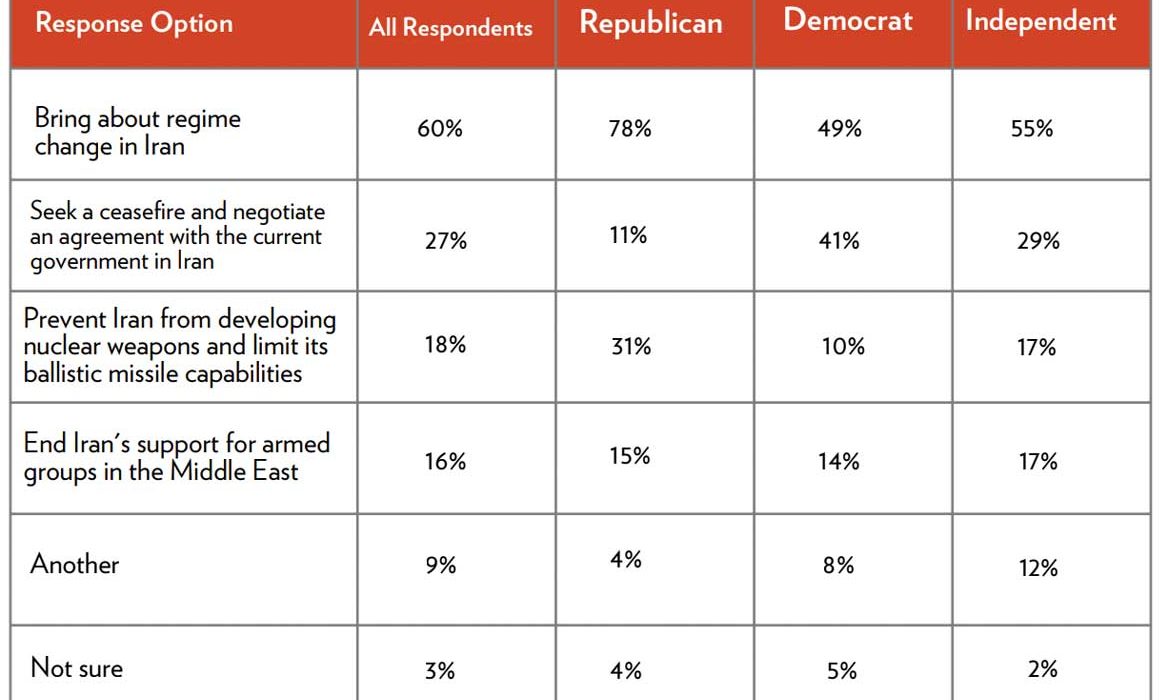
Which of the following do you think should be the main objectives of U.S. policy toward Iran during the current conflict?
PAAIA SURVEY RESULT
Executive Summary
Most Iranian Americans support U.S.-Israeli air strikes on targets in Iran, though nearly half are concerned the current or a more hardline regime could remain in power; roughly three-quarters favor a democratic republic or constitutional monarchy, and a majority support U.S. backing of Reza Pahlavi.
From March 18-23, 2026, Survey USA conducted a national survey of 450 Iranian Americans on behalf of the Public Affairs Alliance of Iranian Americans (PAAIA), examining views on U.S.- Israeli airstrikes against Iran and the future of governance in Iran. The survey has a Median Credibility Interval of +_4.7%. Presented below is a summary of the findings, followed by data tables and a narrative of the results.
Overall, 58% of Iranian Americans support the airstrikes (including 45% who strongly support), while 40% oppose them. Despite this support, respondents express caution about the long-term impact of the conflict. Nearly half (48%) identify their top concerns as the possibility of the current regime or a more hardline alternative remaining in power, while 43% highlight civilian casualties as a primary concern.
When asked about U.S. policy priorities over the current conflict, regime change emerges as the leading objective, selected by 60% of respondents. Other priorities include pursuing a ceasefire and negotiations (27%), preventing nuclear and missile development (18%), and limiting Iran’s support for armed groups (16%).
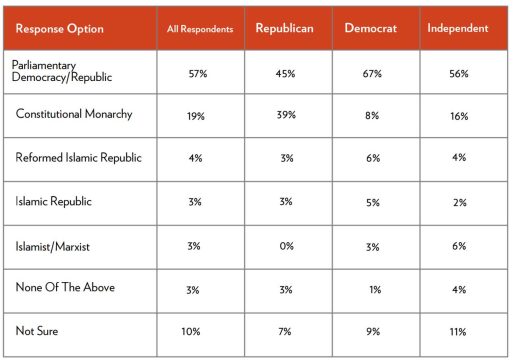
The survey also finds strong consensus around Iran’s preferred future system of governance. A substantial majority (57%) believes a parliamentary democracy or republic would work best for Iran, with an additional 19% supporting a constitutional monarchy. All other governance options receive minimal support.
On the question of U.S. engagement with Iranian opposition groups, a plurality (45%) believes the United States should not take a position on specific opposition leaders or groups, while 42% support such involvement.
However, views differ significantly when specific actors are considered. A majority (59%) support the U.S. government publicly backing Reza Pahlavi as an opposition leader, while support for the Mujahedin-e Khalq (MEK) is extremely limited at just 8%, with broad opposition across the community.
When asked who is most likely to help move Iran toward a democratic system, Reza Pahlavi stands out as the only figure with significant support, selected by 50% of respondents. No other individual or group receives more than single-digit support, while a notable share of respondents (23%) remain uncertain.
Finally, the survey highlights the priorities Iranian Americans believe civic and advocacy organizations should focus on during this period. The top priority is providing humanitarian assistance to people in Iran (46%), followed by promoting internet freedom (37%) and supporting Iranian students, asylum seekers, and those fleeing persecution (25%). Other priorities include cultural preservation, civic engagement, and protecting civil rights in the United States.
Taken together, these findings show a community that supports efforts to counter the Iranian regime and that is strongly committed to a democratic future for Iran, while remaining deeply concerned about humanitarian consequences and long-term stability.
Given current circumstances with Iran, what do you think should be the main priorities of Iranian American civic or advocacy organizations?